
Equine PT Case Study - Hottie
Case studies occupy a unique and valuable space in rehabilitation because they allow us to see how theory unfolds inside a real, living body. Textbooks teach biomechanics in clean diagrams and research papers describe protocols in controlled populations, but horses rarely present in tidy categories. They arrive with their own unique histories, habits, compensations, and personalities that influence how dysfunction expresses itself and how recovery must be approached.
By walking through one horse’s story in detail and examining posture, movement, palpation findings, environmental influences, and response to treatment, we can gain insights that help us approach other individuals in our care. We can see how subtle asymmetries develop over time, how old injuries continue to shape current function, how behavior can reflect physical strain, and how layered compensations reveal themselves during rehabilitation.
Hottie’s case offers an opportunity to connect behavioral changes with physical limitations and biomechanics with real-world management. She reminds us that all behavior is communication and that careful observation, thoughtful assessment, and patient strengthening can meaningfully change both movement and demeanor.
History & Lifestyle
“Hottie” is a 20-year-old chestnut mare. Her owner has known her for almost her entire life and has owned her for 14 years. They still enjoy light trail riding and have recently started introducing clicker training.
Hottie is in a private stall/run for approximately half the day and turned out the other half with one gelding. The owner reports she “tolerates” her current companion but doesn’t love him. Hottie has lost two friends over the years that she loved deeply and the owner reports she went through a significant grief period when they passed.
The owner reports that Hottie stands well for the farrier, she is barefoot and trimmed every 5-6 weeks, but she seems stiff in her hind limbs and does an exaggerated, tense lift when asked to hold up a hind foot.
The horses have 24/7 access to forage whether they are in their stalls or out in the field.
Relevant Medical History
Left hind suspensory ligament tear (2013)
Traumatic injury (2018) where she was run into a fence by a herdmate including large laceration to left shoulder and suspected rib fractures
Recently completed a course of omeprazole
History of colicky symptoms during her cycle, vet prescribed hormone regimen effectively controls sypmtoms
Presenting Complaint
The primary concern prompting this appointment was behavioral and I was referred to this case by the trainer.
The owner and trainer report that Hottie has become increasingly aggressive and reactive in her stall: pinning ears, threatening to bite, and lunging toward people to the point that it feels unsafe to enter her stall and the owner cannot clean the stall while the horse is still inside.
These behaviors are significantly reduced when she is haltered or outside the stall. Following a course of omeprazole, she became somewhat more tolerant of touch, but she remains guarded and the stall-associated aggression persists.
For a horse who has historically been manageable, with the same owner long-term with no obvious changes in her lifestyle or management, this change is especially meaningful (and confusing).
Hottie is not obviously lame when moving around her pen and some professionals have written the behavior off as “being a red mare.” The owner is starting to wonder if her once sweet mare just doens’t like her anymore. She just wants her horse to be happy.
Even when it isnt immediately clear why, behavioral changes — especially increased irritability, defensiveness around touch, or aggression in confined spaces — are often a red flag for discomfort!
Initial Assessment
Static Posture (Before Manual Therapy)
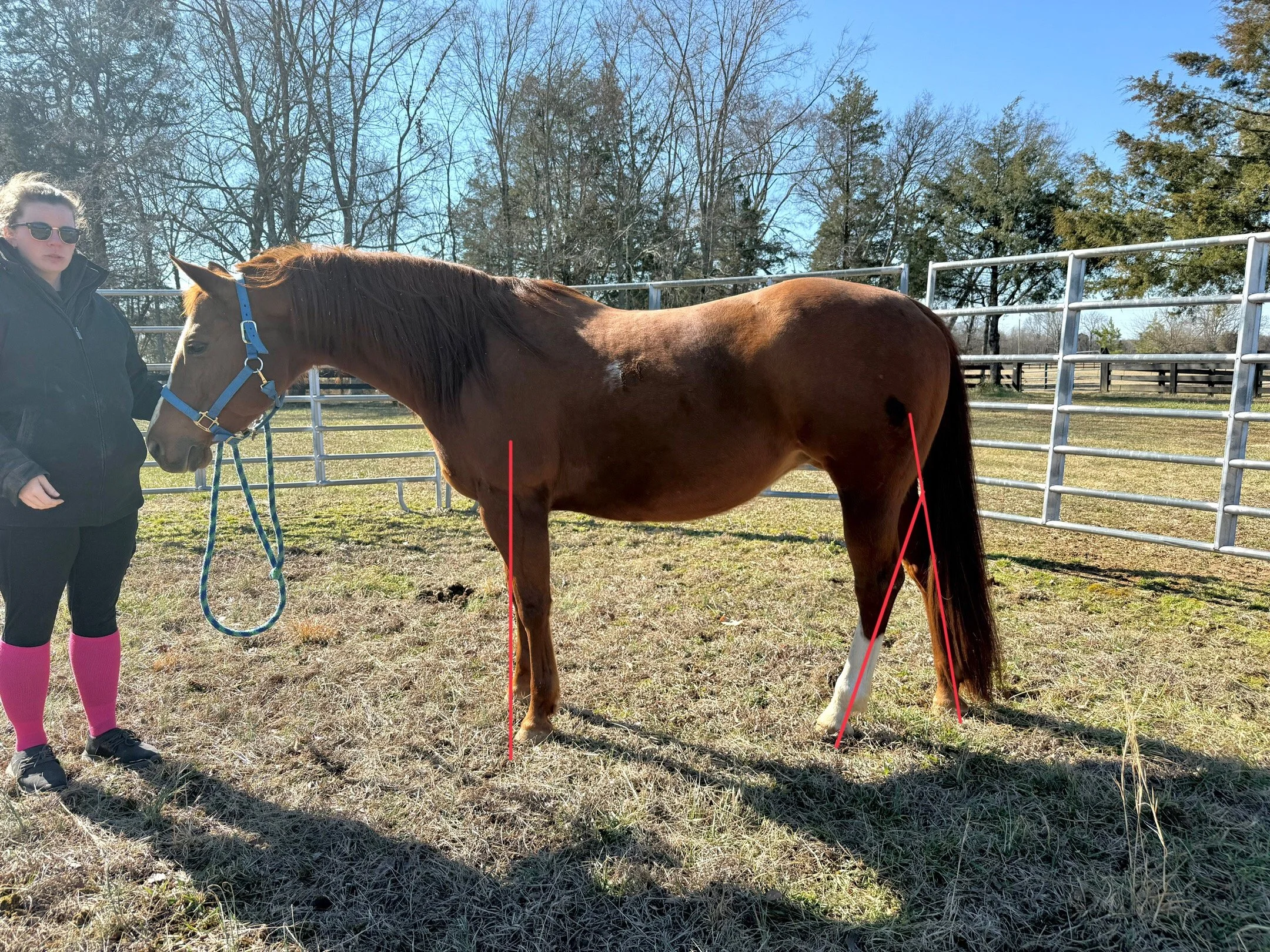
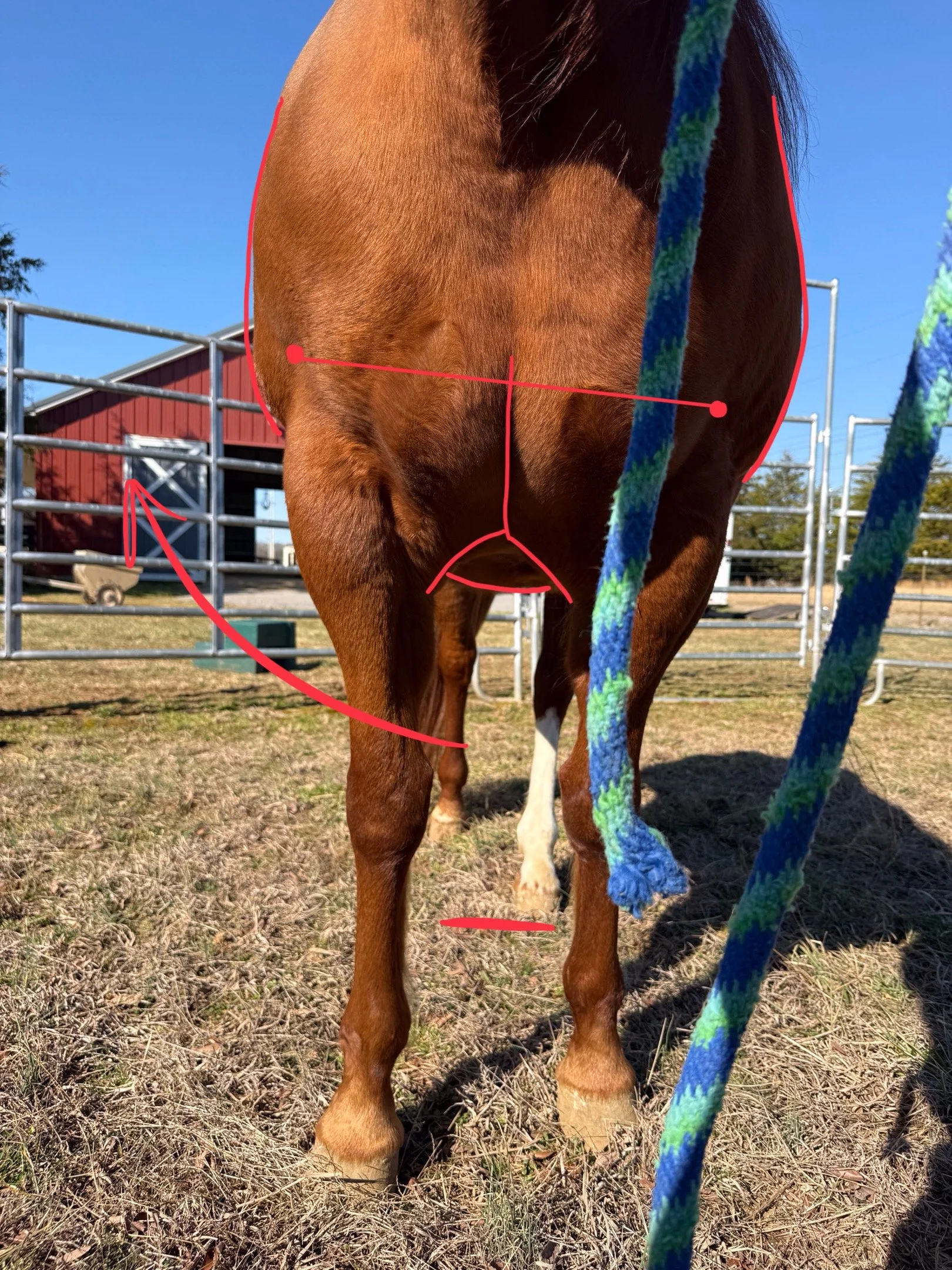
Hottie consistently stood:
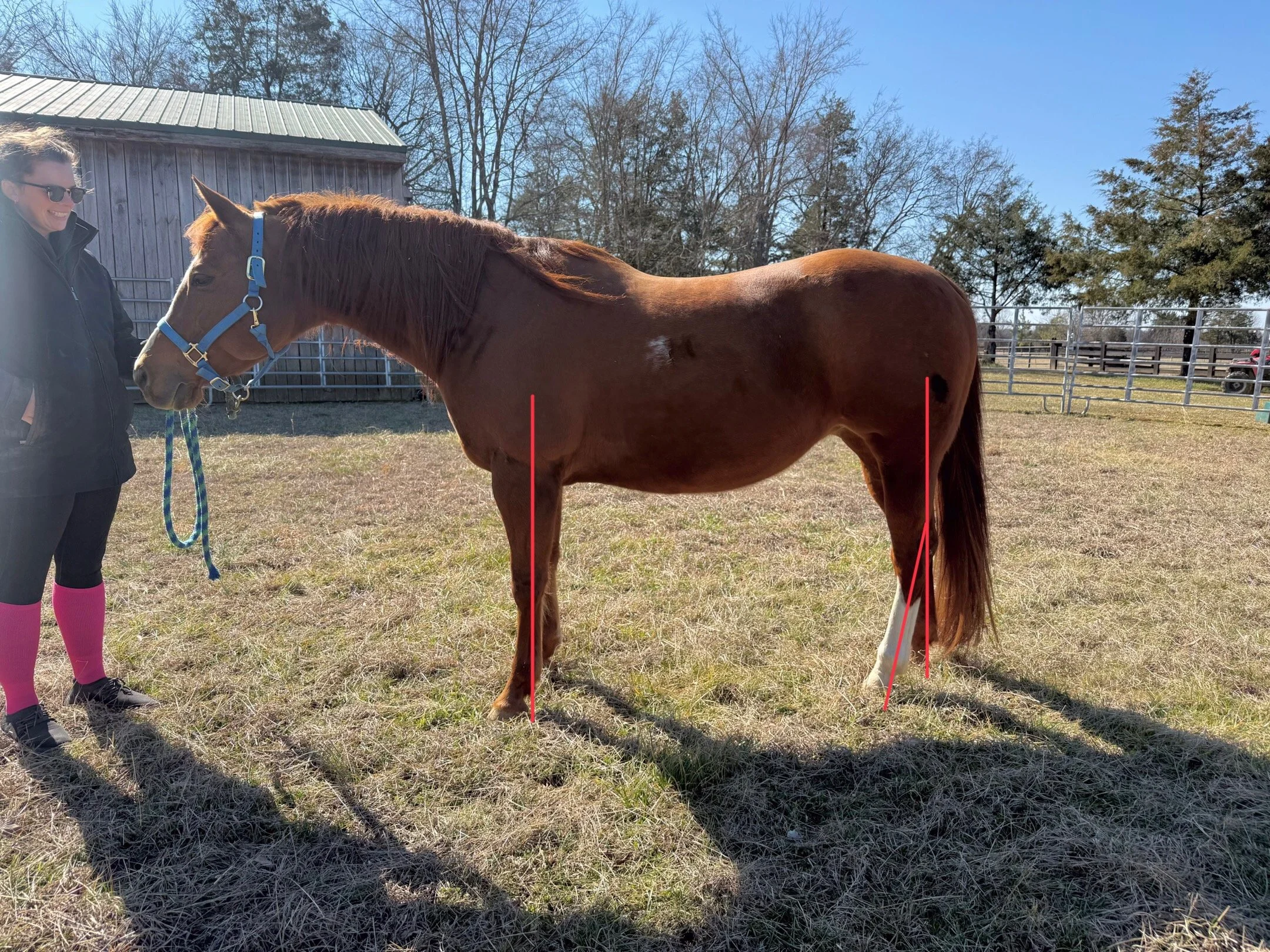
Tipped forward over her forelimbs, unloading her hindquarters.
Left hind positioned forward and slightly toward midline
Pelvis asymmetrically loaded
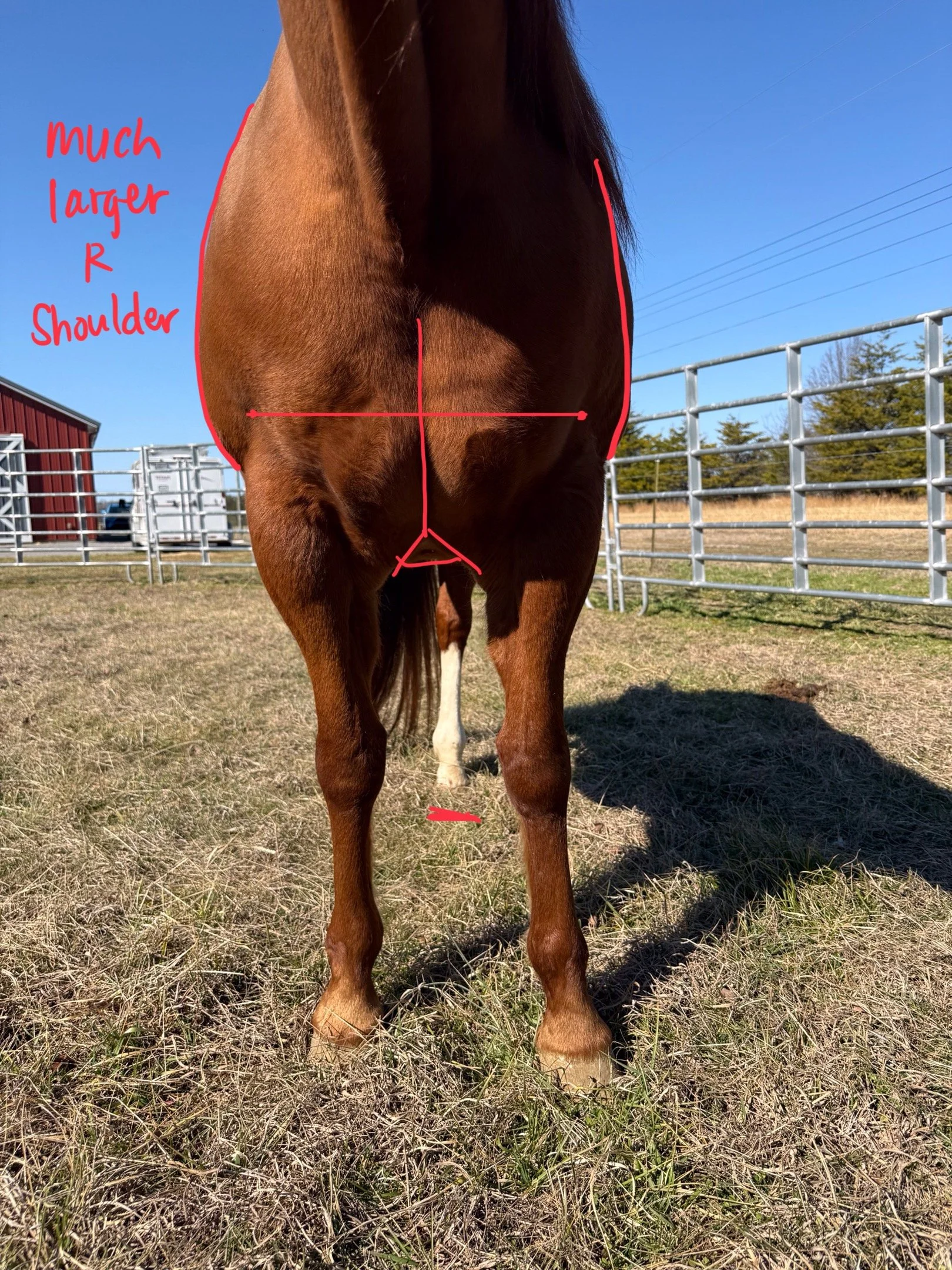
Right shoulder/scapula elevated relative to left
Both hind limbs visible between front limbs (indicating rotation primarily through the shoulder girdle, minimal bend in spine)
Compensation patterns can get a bit confusing when we’re compensating for multiple old injuries in both the hind end, ribcage, and forelimb, but this static posture is consistent with what I would expect to see in a horse with this history who was never completely rehabilitated from their injuries.
Horses are extremely skilled at hiding their little weaknesses! It’s a survival skill they come hardwired with. It’s so easy to miss these little compensations as a horse owner.
Dynamic Assessment
Let’s take a look at how Hottie moves:
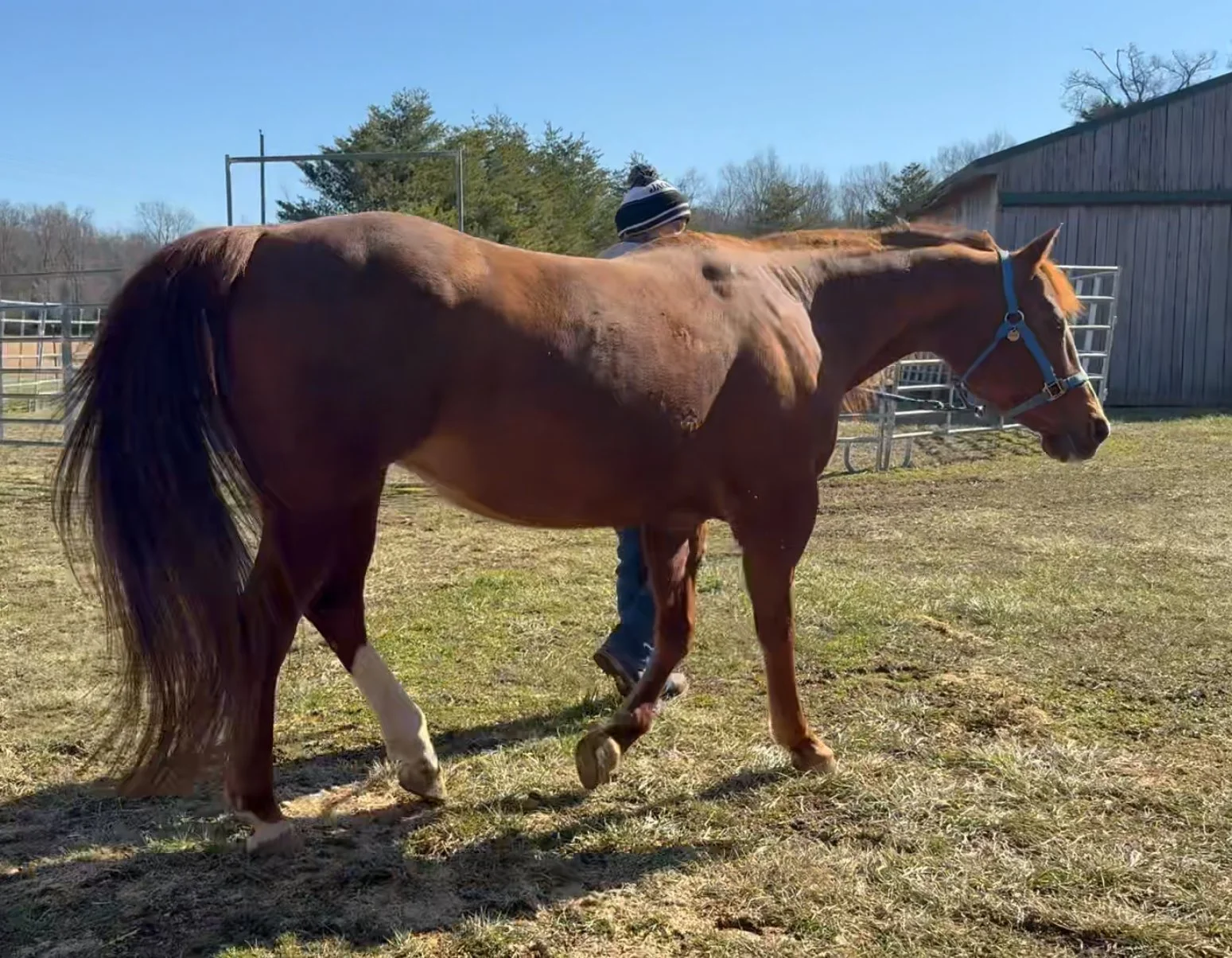
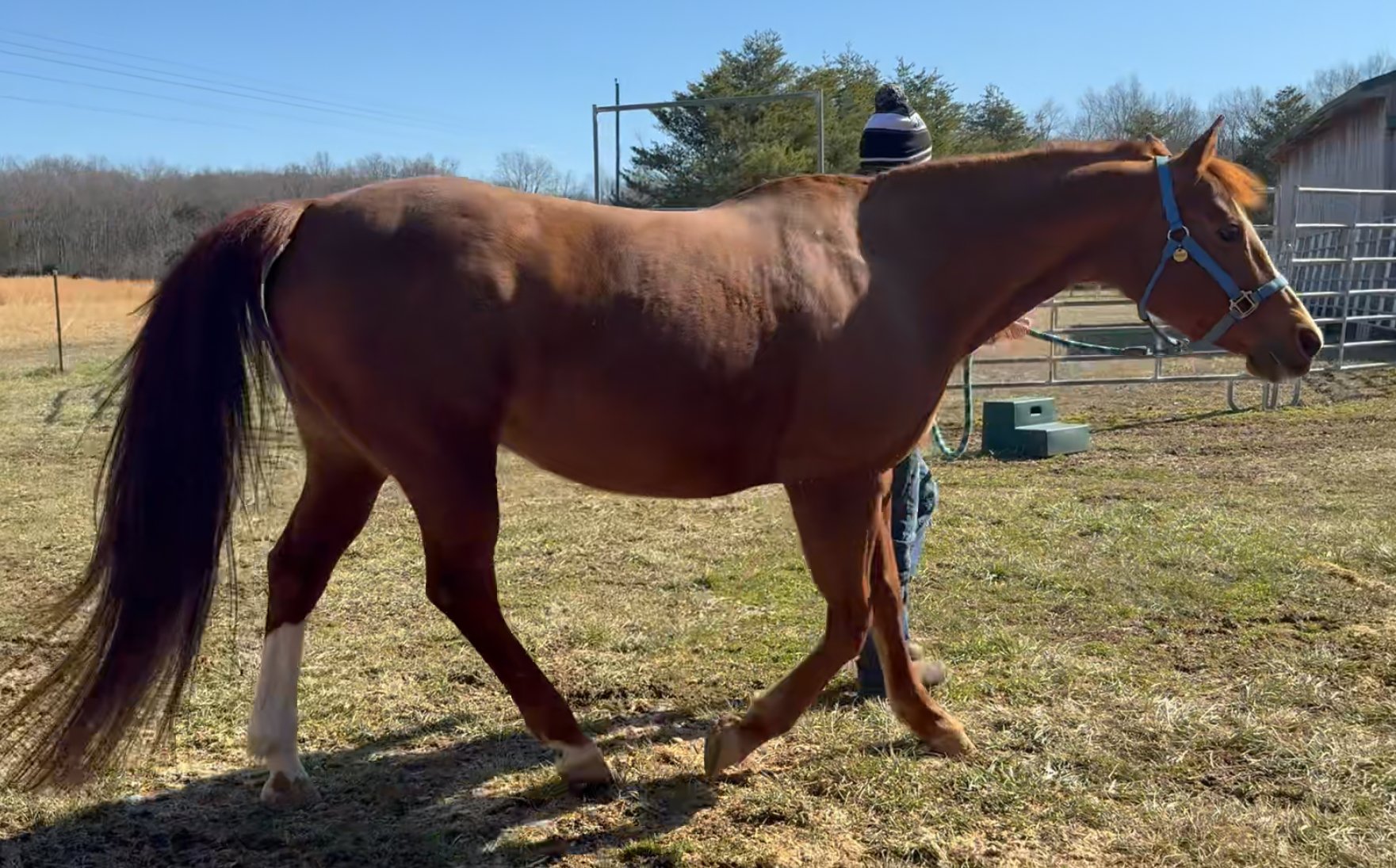
At a walk we could see:
Left hind landing toe-first
Right hind landing flat to heel-first
Left hind taking shorter stride than right
Toe-first landing in a previously injured limb is common when horses avoid fetlock extension or suspensory loading, so this is consistent with her old injury.
Above is her walk video looking from directly in behind and in front. There are things we could nitpick here, but I didn’t see anything immediately too concerning and was actually surprised by the relative symmetry of her pelvic motion.
So I asked for a trot and this is what we got:
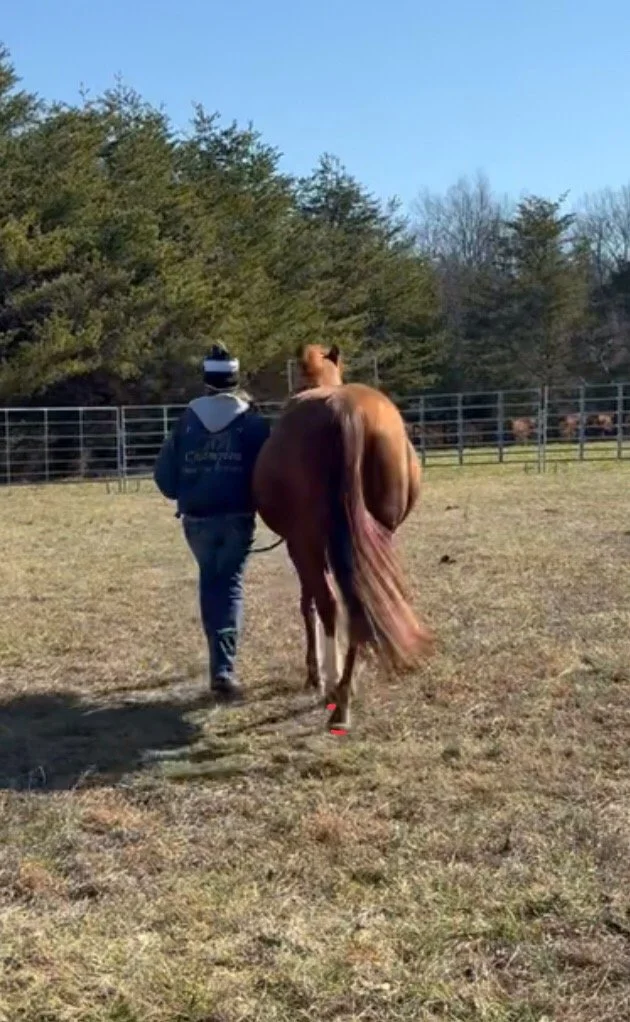
So one of the most obvious things was Hottie’s change in behavior when asked to trot - that angry face we saw in the stall came right back. We can also observe:
Left hind stepping towards midline, trotting in “three tracks” instead of hind feet in line with front feet
Significant drop of the left hip
Reduced pelvic stability
This medial tracking is consistent with poor engagement of the gluteal and deep pelvic stabilizers and chronic offloading of a previously injured limb.
In practical terms: she does not have adequate strength or neuromuscular control to stabilize her pelvis during propulsion. It is hard to see at a walk but becomes quite visible to our human eyes at a trot.
Palpation & Mobility Findings
Hottie was wary of touch, particularly around:
Back
Girth
Chest
Abdomen
She was, however, able to participate willingly when given frequent breaks and the ability to opt out - except for touching her girth. That remained a hard NO throughout the session.
Key findings:
Increased tone in poll musculature (L > R)
Limited passive range of motion into lateral flexion at the poll bilaterally, compensates with cervical rotation
Thoracic sling weakness/lacking motor control (only able to complete 2–3 lifts before fatigue)
Lumbar spine and tail stiffness
Mild bilateral fetlock puffiness (L > R, no heat)
Limited L fetlock extension (active and passive range of motion)
Severely restricted hind limb retraction bilaterally (R more limited than L)
Mildly restricted but symmetrical hind limb protraction
She also demonstrated exaggerated hind limb pickup behavior for me but could coordinate slow, controlled lifting when given tactile cues. This exaggerated lift is often a protective strategy and is tension-driven rather than strength-driven.
Treatment:
Poll - techniques for relaxation including massage, gentle ear circles, grade I-II C1/C2 mobilizations
Shoulder girdle - thoracic sling lifts; therapist gently cueing for horse to lift ribcage between scapulae
Spine - gentle grade I-II mobilizations into sidebending and rotation throughout thoracic and lumbar spine, grade II-IV sideglides throughout tail vertebrae
Hind limbs - massage for circulation to bilateral distal limb, neuromuscular control exercises with slow and controlled limb lift/lowering including lowering into gentle limb retraction (1-4 inches behind standing limb)
Immediate Response to Manual Therapy
After manual therapy:
Forelimbs shifted to a more vertical base of support
Hind limbs standing closer to square
Shoulder girdle more level
Right shoulder asymmetry becomes more visually apparent and we can only see LH between the front limbs, so there is some spinal compensation required to get the shoulders even and some chronic muscular asymmetry that will take time to unwind - she isn’t “fixed” - there are many links in this compensation chain!
Pelvic stabilization improved at trot
Left hind tracking straighter
Hip drop normalized toward expected excursion
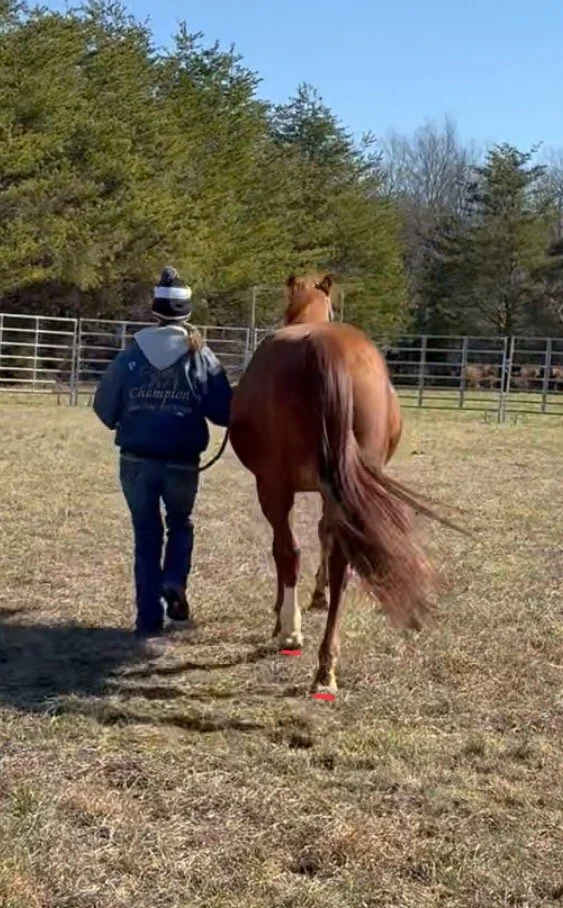
She still lands toe first on the LH
The trot video is not perfect becuase she veers left after only a few strides - here is a screengrab of how that foot is landing:
Clinical Interpretation
Hottie’s physical presentation is consistent with long-term compensation patterns following her previous injuries.
The 2013 left hind suspensory injury likely initiated chronic unloading of that limb. The 2018 left shoulder trauma likely further disrupted symmetrical loading patterns through the forehand and thoracic sling.
For years, she managed these compensations.
At 20 years old, her capacity to maintain these patterns without discomfort has diminished.
The result:
Increased mechanical strain
Thoracic sling weakness
Pelvic instability
Lumbar stiffness
Heightened sensitivity to touch
Behavioral defensiveness that is exacerbated in confined environments
Importantly, she appears more guarded when multiple people are around her (even in open spaces) and more reactive in confined spaces like her stall.
This may reflect:
Claustrophobia or perceived lack of control
Association of confinement with discomfort
Protective guarding behavior when she cannot easily move away
Behavior is information.
In Hottie’s case, it is likely an expression of accumulated physical strain combined with environmental stress.
What This Case Teaches Us:
Hottie’s case is not unusual. In fact, it represents something we see often in aging horses with old injuries: the slow unraveling of compensation patterns that once worked well enough but have now become painful.
Here are the key lessons her case highlights.
Behavior Is Often a Physical Story
When a horse becomes:
Irritable or grumpy
Defensive about touch
Aggressive in confined spaces
“Cranky” during handling
…it is worth asking what their body might be struggling with.
Hottie’s aggression was not random. It coincided with:
Thoracic sling weakness
Pelvic instability
Lumbar stiffness
Guarding around the girth and abdominal region
Confined spaces reduce a horse’s ability to move away from discomfort. For a horse already compensating and feeling physically vulnerable, that can escalate stress responses.
Old Injuries Don’t Disappear — They Adapt
Hottie’s left hind suspensory injury occurred in 2013. Her shoulder trauma in 2018. I’m writing this case study in early 2026.
She has been functioning quite happily for years! She has an owner who loves her dearly and takes excellent care of her. This owner hasn’t done anything wrong, the horse had routine and appropriate veterinary care. The remaining issues were subtle and easy to miss because Hottie found ways to compensate that worked for her for many years.
But compensation is not the same as resolution.
Over time the body becomes less and less capable of continuing in the compensatory pattern and eventually some part of that biomechanical chain starts to break down, become painful, or can even become a new site of injury.
In Hottie’s case:
Her thoracic sling weakened. The owner reports she always had a tendency to move on the forehand but now just “pulls herself along with her front end”
She can’t get off the forehand because her hind end is unstable!
Pelvic stability was lost
One of the most common compensations after any injury is that the deep stabilizing muscles become inhibited and our larger muscles (the movers) attempt to take over the job and become stabilizers. While this can work for a while, these muscles are not designed to fire the same way a stabilizer does (low-level contraction but almost always “on” to some degree vs. higher level contraction only when moving a limb, for example) and eventually get angry, painful, and tense from long-term attempts at compensation.
Lumbar stiffness increased, trying to protect herself
Our bodies natrually attempt protect ourselves from pain by reducing range of motion. The brain tells us motion is unsafe and over time this leads to stiffness in joints in addition to the muscular tension mentioned above.
Protective movement patterns became habitual, she never learned that it was safe to move out of them and so she kept them. This happens in people, too. You walked funny for a few weeks after a sprained ankle and continued to slightly offload that limb even after the ankle was healed. 5 years later you might have knee, hip, or low back pain with no clear cause….
At 20 years old, her system no longer has the same reserve capacity to maintain those patterns comfortably. Her aging didn’t create the dysfunction, but it did reveal it.
When One Compensation Improves, Another May Become Visible
After manual therapy, in standing Hottie’s shoulders appeared more level, but her spinal and pelvic asymmetries became more apparent.
Because she was able to move in a more functional way with better use of her left hind, this tells me that we made progress overall and we can continue working along this path.
If her shoulders leveled and her use of her hind end remained unchanged or got worse, I would be re-evaluating my treatment plan.
This is common in rehabilitation. When we remove the most dominant compensation, the next weakest link often shows up. True rehabilitation requires layered progression, not one-time “fixes.”
I think about it like slowly peeling layers of an onion. It takes time.
Resting Posture Tells an Important Story
Before therapy, Hottie:
Tipped forward over her forelimbs
Positioned her left hind forward and toward midline
Demonstrated toe-first landing on the previously injured limb
These are subtle but significant findings.
Owners can learn to watch for:
One hind consistently resting forward
Toe-first landings
Crossing midline at the trot
Asymmetrical hip drop
Forward weight shift onto forehand
These are often early signs of core instability or limb offloading.
Rehabilitation is About Feeling Safe
Hottie’s exaggerated hind limb lifting wasn’t “bad behavior.” Her bite threats as you reached out to touch her wasn’t just “being a red mare.”
It was tension and protective guarding.
When given tactile cues and processing time, she could coordinate slow, controlled limb lifting.
She demonstrated significant functional improvements with extremely gentle techniques - no aggressive adjustments or stretches. For horses like Hottie, empowerment and autonomy during therapy are not optional — they are therapeutic.
This reminds us:
The nervous system is primary.
Motor control is different from strength.
When we rehabilitate long-term compensatory patterns and seek to reduce pain in our patients, helping that patient feel SAFE in their body, SAFE in the new ranges of motion we explore, SAFE in their movements is of primary concern.
Our brains create compensatory patterns to keep us safe and protect the injured site. Sometimes when that injury has healed, the brain still thinks the area needs protecting. This can lead to chronic pain and compensation that cannot be resolved without therapeutic help - help to retrain the brain that the area is in fact safe to load, safe to move, safe to be touched.
You cannot create a sense of safety with aggressive or painful techniques or even by forcing gentle techniques on a nervous horse.
Environment Matters More Than We Might Think
Hottie’s defensiveness increased:
In her stall
When multiple people surrounded her
It decreased:
In the field
When working one-on-one
A horse that feels trapped while uncomfortable may escalate defensively. We need to use this information in our rehabiliation plan. Her owner’s homework will be done out in the open for a while and we will monitor how Hottie’s behavior changes. Hopefully we can see her become more comfortable and less defensive in her stall over time, and then we might intentionally add some relaxation exercises in the stall to help rebuild positive associations in confined spaces.
Attempting to force Hottie to tolerate exercises somewhere that she doesn’t feel safe would be counterproductive - even if we are certain the exercises or therapeutic techniques would be helpful.
Increasing turnout, minimizing confinement stress, and allowing opt-out moments during rehab are not just “nice to have” they can directly influence outcomes.
How Owners Can Apply This to Their Own Horses
If you have an older horse or a horse with a history of injury:
✔ Watch posture in quiet moments.
✔ Pay attention to subtle changes in attitude.
✔ Notice if aggression increases in confined spaces.
✔ Address strength and stability before returning to higher workload.
✔ Don’t assume a resolved injury means a fully restored system.
Most importantly:
Early intervention is easier (and faster) than unraveling years of compensation. So catch things early if you can - but don’t beat yourself up if you missed it.
Final Thought
Hottie does not need to return to perfect symmetry to have a good quality of life.
She needs:
Improved stability
Reduced protective guarding
Strength appropriate to her age and use
An environment that supports her comfort
Her prognosis for return to light riding is very good!
She is lucky to have an owner who will love and cherish her through her retirement years.